📍 STATUS: Loading Reality Check...
🚀 WARNING: Being immersed in the world created by social media comes with hidden costs.

                                💻 📃 📩
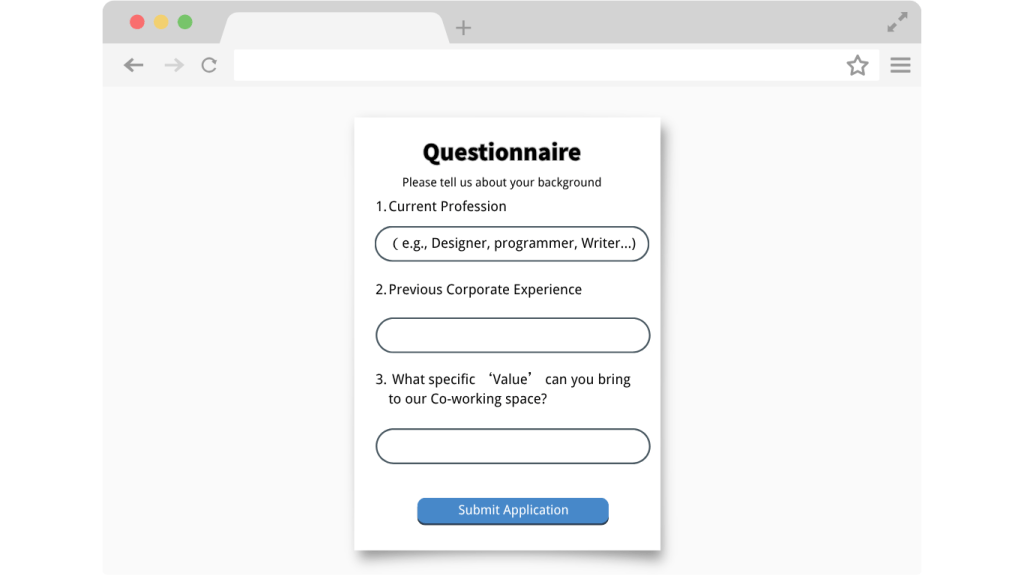
A digital questionnaire in a web browser asking applicants for their corporate background and the specific value they bring to the co-living community. Image by author Lia Ling.
The first time I saw a table like this one above, I thought it was the form that the company required us to submit during the interview.
Your previous profession,
Your previous corporate experience,
What you can do for us…?
Shouldn’t this be answered during the interview? When we finally decide to escape the suffocating company and prepare to join a so-called “freedom” digital nomad co-living community, this is our welcome mat.
Filter Breaker is not here to tell you that these digital nomads’ co-living communities are scams. However, it is our responsibility to reveal a harsh reality:
" Freedom" has a grittiness.
Utopias have entry requirements. When you choose to join, you are directly stepping into a new cultural gatekeeping.
From Enterprise KPI to Value-Based Selection
In the traditional corporate machine, human resource departments filter us based on our labour output and KPI. You might assume that quitting your job and becoming a digital nomad, fleeing to a rural co-working space, you have bypassed this system entirely.
The reality is far more ironic. The screening mechanism has not disappeared; it has merely changed.
Today, these co-living utopias have replaced HR recruiters with community managers. They implement a strict screening mechanism: the “value-based selection” mechanism. The managers screen the applicants based on their educational background, career, and personal interests. This means that shared office spaces are no longer a safe haven for those who are tired of the 9-to-5 grind. It is a highly curated social club.
In an extensive case study of the Anji digital nomad community, access is shown to be strictly conditional. You must clearly prove that you [love rural life] and commit to a minimum stay to ensure social integration.
Redefining the Boundaries of Freedom
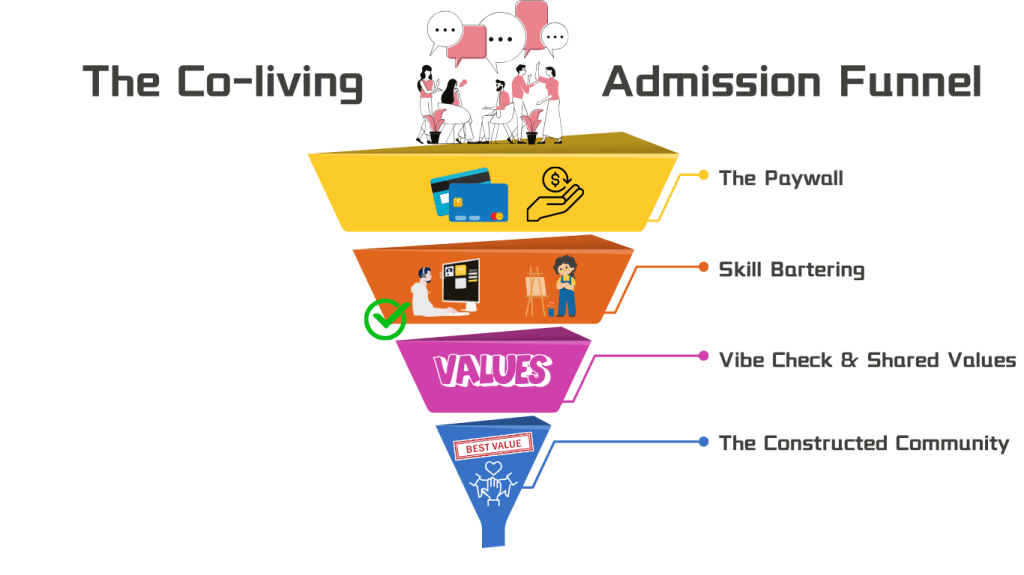
In Western nomad hotspots, the barrier to entry is often a “paywall”, and this transaction model is regarded as the commodification of community.
In a nutshell, all you need to do is spend money to obtain a sense of belonging.
Whether-
- It’s 💰$20 a night for a room
- 💰&30 premium “community membership” for gym and meeting room access
But in China’s co-living spaces, the barrier to entry has evolved into a cultural threshold. Managers use “shared values” as the ultimate admission ticket. Unlike the traditional nomad hotspots, where money buys access, hubs like Anji require you to actively co-create the community using your professional skills.
As documented in recent fieldwork, your profession and past experiences determine your utility to the community. If you are an ex-tech programmer from a grant tech company, you might be expected to host weekend AI workshops for non-tech residents. If you are a freelance illustrator or designer, you will be quickly appointed to co-create the local community journal.
In this environment, your core “precision hardware” – your professional skills and past experiences -becomes your social currency. You have not escaped the need for your skills by the enterprise; you have merely exchanged your salary for a sense of belonging, paying the “freedom” price through mandatory community contributions.
Would you like to know in detail how this invisible screening happens?
Click the link below to listen to a 5-minute podcast,
where Lia Ling will dissect this screening mechanism.
👇👇Click click
The Reality Check: Utopias Are Not Free
Ultimately, this highly curated screening process creates exactly a constructed community. By filtering residents based on their professional values, these co-living communities unintentionally build an exclusive bubble. If you want to find a quiet and reasonably priced desk to work alone, you might be marginalized. Here, freedom is conditional. To survive in this ecosystem, you will be subtly forced to provide social value under the guise of “co-creation”. This compulsory social behavior gradually stifles the absolute autonomy that digital freelancers initially pursued.
Before you impatiently click the “submit” button on that digital intake application form, please take off the filter of social media. Understand that you are not stepping into an absolutely free domain, but rather a private club with its own strict cultural threshold. True autonomy begins when you truly understand the rules of the game you are playing. Before you submit that application form to seek “like-minded” people, stay alert:
Are you pursuing the freedom to escape the internal competition?
Or are you buying a VIP ticket to enter a new privileged isolation zone?
 Filter Breaker
留下评论